Is It Normal for a Straight Man to Think About Other Men?
- Lana

- Jun 24
- 5 min read
If this is the question you’ve been too afraid to type, read this before you panic.
I’m Lana, an erotic identity coach and dominatrix who works with men navigating shame, fantasy, identity, submission, and sexual curiosity. This question is one I hear far more often than most people realize.
You’re straight. You’ve always been straight. You’re attracted to women, you want women, your life is built around that and then a thought shows up that doesn’t fit, and your stomach drops. Maybe it’s a flicker while watching porn. Maybe it’s a specific curiosity you can’t explain. Maybe it’s just there, uninvited, and now you’re lying awake running the same loop: does this mean I’m not who I thought I was?
Take a breath. This is one of the most common secret questions men carry, and the honest answer is reassuring, but it’s also more interesting than a simple yes or no.
The short answer
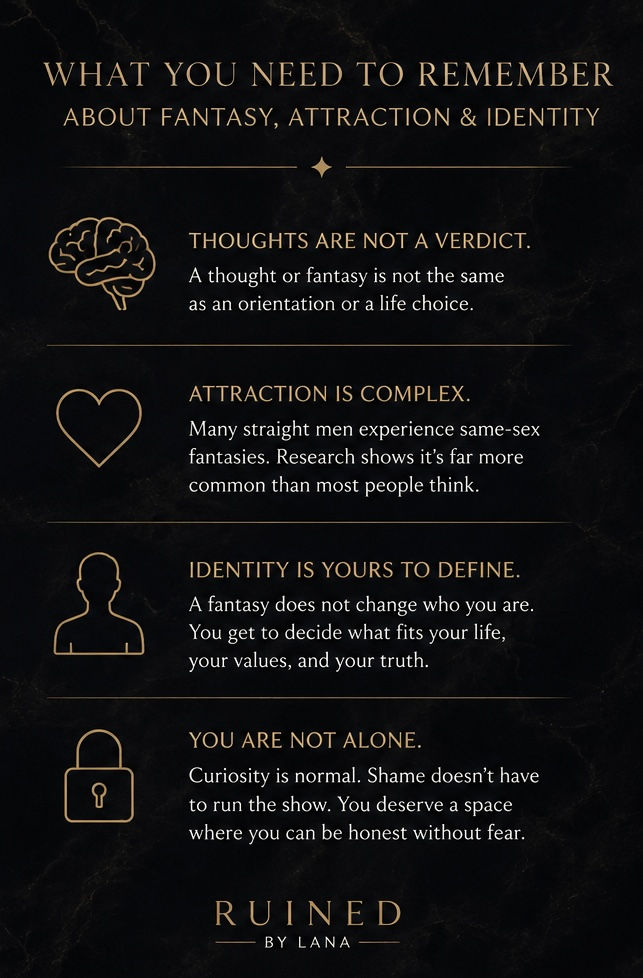
Yes, it’s normal. Having an occasional thought, curiosity, or even fantasy about other men is far more common among straight men than the silence around it would ever suggest. It does not, on its own, mean you’re secretly gay, that your marriage is a lie, or that something is broken in you.
What it actually means takes a little unpacking and the unpacking of this is where you can find relief.
What the research shows
The numbers are not what most men assume.
In a survey of nearly 4,000 Americans, sex researcher Dr. Justin Lehmiller found that
roughly 26% of straight men reported having had same-sex fantasies. That’s about one in four men who identify as straight — not as bisexual, not as questioning, but as straight — who’ve had a fantasy like the one keeping you up.
When researchers analyzed national survey data, they found that a majority of men who reported some current same-sex attraction — around 59% — still identified as heterosexual. Not closeted or in denial. Straight.
Cornell researcher Ritch Savin-Williams has spent years studying exactly this group, which he calls “mostly straight” men: men who have a small degree of same-sex attraction, don’t identify as gay or bisexual, and aren’t hiding anything. The attraction is real — it shows up even in involuntary physical measures — and so is the straight identity. Both are true at once.
You are, in other words, in extremely ordinary company.
Attraction, fantasy, and identity are three different things
This is the distinction that takes the floor out from under the panic.
We’re taught to treat these as one switch: if you’re attracted to men at all, you must be gay. But researchers who study this separate it into distinct layers: who you’re
attracted to, what you fantasize about, how you behave, and how you identify. And those layers routinely don’t line up. A man can have a same-sex fantasy and a rock-solid straight identity. The fantasy is data about your erotic imagination; it is not a verdict on your orientation.
There’s also a difference between erotic curiosity and romantic orientation. Being turned on by an idea, an image, or a taboo is not the same as wanting to build a life or fall in love with a man. Arousal is broad and a little chaotic; it responds to novelty, to the forbidden, to the very act of “I’m not supposed to find this hot.” Identity is something else entirely. Conflating the two is what turns a passing thought into a full-blown crisis.
Why the panic feels so enormous
If a same-sex thought sends some men into a tailspin while others just shrug, it’s worth
asking why the reaction is so intense; the intensity is usually about identity, not desire.
For a lot of men, “straight” isn’t just an orientation; it’s load-bearing. It’s tied to how they see themselves as men, how they believe their wife or friends see them, the whole structure of a life. So when a thought arrives that seems to threaten that structure, the alarm isn’t really about the thought, it’s about everything the thought seems to put at risk. That’s why the same flicker that barely registers for one man feels catastrophic for another.
And here’s the trap: the harder you fight the thought, the louder it gets. Trying to not think about something guarantees you’ll think about it. The distress compounds, you read the distress as proof, and the loop tightens. Most of the suffering here isn’t caused by the desire. It’s caused by the war against it.
What it might actually be telling you
Curiosity rarely points at nothing, but it also rarely points where you fear.
Sometimes a same-sex thought is simple erotic curiosity, the mind doing what minds do, wandering toward the unfamiliar. Sometimes it’s tangled up with submission or taboo: the appeal isn’t really another man so much as the surrender, the loss of control, the thrill of an act you’ve been told is off-limits. Sometimes it’s about wanting to be desired, or wanting to stop performing a version of masculinity that’s exhausting to hold up. And occasionally, for some men, it is part of a genuine, low-level fluid attraction that can sit comfortably alongside a straight life.
You don’t have to know which it is right now. You don’t have to act on any of it. But
understanding what the thought is reaching for (instead of just bracing against it) is what turns it from a threat into information.
When it’s anxiety rather than desire
One honest caveat, because it matters. For some men, these thoughts don’t feel like
curiosity at all, they feel like dread. The thought is unwanted, it triggers intense anxiety, and it loops compulsively no matter how much reassurance you get. If that’s closer to your experience — the thought brings no arousal, only fear, and you’re checking and re-checking your own reactions for “proof” — that pattern looks less like hidden desire and more like an anxiety presentation (sometimes informally called sexual-orientation OCD).
That’s not something to white-knuckle alone, and it’s not a character flaw. A therapist who works with anxiety and OCD can help, and reaching out is a sign of good sense, not weakness. The tell is the feeling: genuine curiosity is open and a little warm; anxiety is closed, dreading, and desperate for certainty.
You don’t have to have it figured out
The reason this question torments so many men is that they have nowhere to ask it. You
can’t say it to your wife without it becoming A Whole Thing. You can’t say it to your friends. So it stays sealed, and the silence does what silence always does to shame, it makes it bigger.
It doesn’t have to stay sealed. A confidential space to actually look at the thought — without panic, without judgment, without it being treated as a confession you have to survive — is often all it takes for the whole thing to come back down to size. To be ruined isn’t to be broken. It’s to finally stop being afraid of your own mind.
Related reading: Is it normal to have taboo fantasies? — the bigger picture on why almost nothing you fantasize about is actually unusual.
If you’re ready to understand what this curiosity is really about, you can apply here.
References
Lehmiller, J. J. (2018). Tell Me What You Want: The Science of Sexual Desire and How It Can Help You Improve Your Sex Life. Da Capo Press. (Survey of 4,175 U.S. adults.)
Savin-Williams, R. C. (2017). Mostly Straight: Sexual Fluidity Among Men. Harvard University Press.
Analysis of U.S. National Survey of Family Growth data (2011–2015) on the relationship between same-sex attraction, behavior, and heterosexual identification.
